Building Emotional Strength: A Practical Guide to Emotional Resilience, Mindset Shifts, and Self-Awareness
Emotional resilience is the ability to stay steady during stress, recover after setbacks, and respond with intention instead of impulse. Building emotional strength is not about avoiding difficult feelings—it’s about developing skills to notice what’s happening inside, regulate the body’s stress response, and choose actions aligned with values. The steps below focus on small, repeatable mindset shifts and self-awareness practices that compound over time.
What Emotional Strength Looks Like in Real Life
Emotional strength often shows up in subtle, practical moments—not as “never getting upset,” but as recovering and responding better over time.
- Bouncing back after a hard day without staying stuck in rumination or self-criticism.
- Noticing emotional triggers early (tight chest, racing thoughts, irritability) and pausing before reacting.
- Holding two truths at once: “This is hard” and “This is workable.”
- Recovering faster after conflict by repairing, setting boundaries, or letting go of unhelpful narratives.
- Staying consistent with supportive routines even when motivation dips.
The Core Skills Behind Resilience: Awareness, Regulation, Reframe, Action
A helpful way to think about resilience is as a loop you can run again and again. When stress hits, you don’t need a perfect response—you need a repeatable one.
- Awareness: identifying emotions accurately (stress, shame, disappointment, grief) rather than labeling everything as “anxiety” or “anger.”
- Regulation: using body-based tools to downshift from fight/flight/freeze into a calmer state where thinking is clearer.
- Reframe: challenging extreme interpretations (“always,” “never,” “I can’t”) and replacing them with balanced, reality-based language.
- Action: choosing the next best step—one small move that supports safety, connection, competence, or rest.
- Practice principle: resilience improves with short, frequent reps rather than occasional big efforts.
Four-Part Resilience Loop (Quick Reference)
| Skill |
What it does |
Try this in 60 seconds |
| Awareness |
Names what’s happening so it can be addressed |
Ask: “What emotion is here, and what does it want?” |
| Regulation |
Calms the nervous system so the brain can problem-solve |
Exhale longer than inhale for 6 slow breaths |
| Reframe |
Reduces catastrophic thinking and black-and-white stories |
Replace “I can’t handle this” with “This is hard, and I can do the next step” |
| Action |
Turns insight into progress and self-trust |
Pick one task under 10 minutes and start it |
Mindset Shifts That Build Emotional Strength
Mindset shifts work best when they’re practical—phrases you can reach for when emotions run hot. The goal is a sturdier inner language that makes room for both truth and progress.
- From “Why is this happening to me?” to “What is this teaching me about my needs, limits, or values?”
- From “I must feel better first” to “I can take a supportive step while feeling this.”
- From “If I’m upset, something is wrong” to “Emotions are signals, not verdicts.”
- From “I failed” to “Something didn’t work; adjust the approach.”
- From “I should be over this” to “Healing is non-linear; progress can look like shorter recovery time.”
Self-Awareness Practices That Make Change Easier
Self-awareness is what turns emotional life from confusing to workable. When you can spot patterns and name needs, you can respond with more precision—and less self-blame.
- Trigger mapping: note the situation, the thought, the body sensation, the emotion, and the impulse (argue, withdraw, numb, overwork).
- Needs check: identify which need is unmet (rest, respect, clarity, support, autonomy, reassurance, safety).
- Values check: ask whether the next response moves closer to the person you want to be under pressure.
- Pattern spotting: look for repeated loops—same conflict theme, same avoidance habit, same inner critic script.
- Compassionate witnessing: describe feelings as if narrating weather (“a wave of sadness,” “a spike of anger”) to reduce fusion with the emotion.
How to Build Emotional Resilience Day by Day (A Simple Weekly Rhythm)
Resilience grows with structure that’s light enough to repeat, even on messy days. Use this as a flexible rhythm—not a test you pass or fail.
For additional, research-informed guidance on stress and coping, see resources from the American Psychological Association, the National Institute of Mental Health, and the World Health Organization.
A Guided Resource to Keep You Consistent
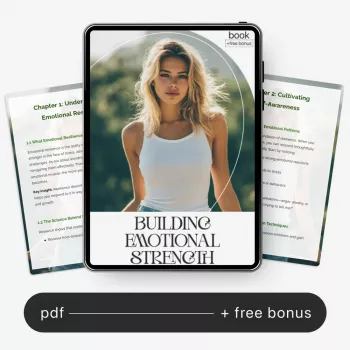
- Building Emotional Strength | Emotional Resilience Ebook for Personal Growth, Mindset Shifts & Self-Awareness | how to build emotional resilience Guide offers structured prompts and step-by-step exercises designed to strengthen emotional regulation, clarity, and recovery after setbacks.
- Using AI to Support Kind Self-Talk When You Feel Low – Digital Guide for Emotional Wellness, Mindful Healing & How to Use AI for Kind Self-Talk When I Feel Low supports more balanced inner dialogue when you’re discouraged, activated, or stuck in self-criticism.
- A Smart Guide to Tracking and Achieving Your Goals – AI Weekly Review System for Goals, eBook, Checklist, Productivity Guide pairs well with resilience work by helping you review patterns, adjust plans, and build follow-through without relying on motivation alone.
Common Roadblocks (and What to Do Instead)
FAQ
How long does it take to build emotional resilience?
Small daily practices can create noticeable shifts within a few weeks, especially when they focus on nervous-system regulation and naming emotions accurately. Deeper pattern change usually takes longer, and setbacks are often part of the learning curve rather than proof it “isn’t working.”
What are quick ways to calm down when emotions feel overwhelming?
Try a long-exhale breathing pattern (exhale longer than inhale), sensory grounding (5-4-3-2-1), brief movement (a brisk 2-minute walk), cold water on the face, or simply labeling the emotion and rating it 0–10. Calming tools don’t erase feelings—they help you regain choice.
Is emotional resilience the same as suppressing emotions?
No. Resilience involves noticing and processing emotions while choosing effective actions; suppression is pushing feelings away, which often increases stress and makes emotions rebound later. Emotional strength tends to grow when feelings are acknowledged and guided, not ignored.
Recommended for you













Leave a comment