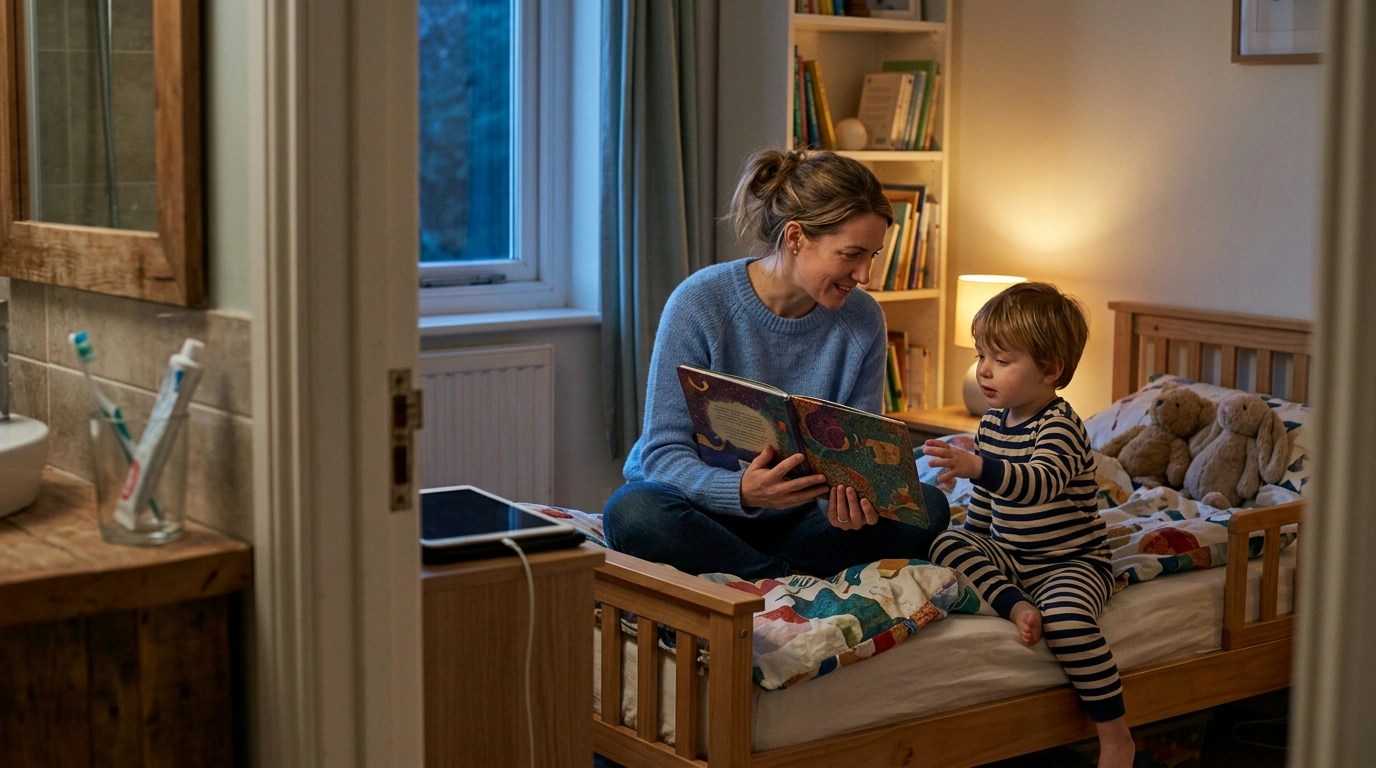
When a favorite show ends just as bedtime begins, the switch can feel abrupt for a child—and exhausting for you. A screen-free bedtime routine gives the evening a more predictable shape: screens end, familiar tasks follow, and there is still time to connect before goodnight. It does not have to make every night perfectly calm to be useful. The goal is a sequence you can repeat and return to, even after a difficult evening.
Begin with the time your child needs to be in bed, then work backward. Leave room for washing up, brushing teeth, pajamas, and one quiet activity rather than trying to fit them all into the last few minutes. Sleep needs vary by age; the American Academy of Pediatrics’ guide to children’s sleep needs can help you set an age-appropriate goal. The CDC’s overview of sleep also offers useful background on healthy sleep habits.
Set a clear stopping point for videos and games before the bedtime steps begin. You might say, “When this episode ends, the tablet goes on its charger, and we choose a book.” Keeping devices in their usual charging spot outside the bedroom makes that transition visible. If possible, avoid starting a game or video that cannot reasonably finish by the agreed time.
A predictable cue matters more than a flawless evening. Some nights, your child will move on easily; other nights, they may be disappointed. You can keep the same stopping point without expecting the same mood every time.
Use a few steps in roughly the same order most nights. That way, you spend less time negotiating what happens next. Small choices can help your child participate: “Blue pajamas or green?” and “Which of these two books?” offer control without reopening the question of whether it is bedtime.
The sequence below is a starting point, not a strict schedule. Adjust its length for your household, your child’s age, and the time you have available.
| Step | What to do | Why it helps |
|---|---|---|
| Put screens away | End videos and games, then place devices in their usual charging spot. | Creates a clear transition away from screen activities. |
| Get ready for bed | Wash up, brush teeth, and put on pajamas. | Makes necessary tasks part of a familiar pattern. |
| Choose a quiet activity | Read together, tell a short story, or listen to soft music. | Offers a chance to connect without returning to a screen. |
| Say goodnight | Use a brief, consistent phrase and turn out the light. | Signals that the routine is complete. |
If your child does better seeing the plan, post a short checklist at their height. You can point to the next step instead of repeating a string of instructions. Talk through the checklist earlier in the day, too, when neither of you is trying to manage a bedtime disagreement.
An advance reminder gives your child time to anticipate the change. Use a cue you can follow through on, such as “After this episode, we put the screen away.” When the agreed point arrives, move directly to the next prepared activity. An invitation to pick a book is more concrete than “Find something else to do.”
You can acknowledge frustration without adding more screen time: “I know you wanted to keep watching. It’s hard to stop. Let’s choose our story.” Keep your words brief and your next step steady. If the change is consistently overwhelming, start smaller. Establish one reliable screen-free part of the evening—perhaps reading together after devices are put away—then build out the rest of the routine.
Our Lights Off, Calm On screen-free bedtime guide for kids is a dedicated resource if you want help building and maintaining a bedtime routine without screens. Use it to support a plan that fits your family, rather than treating any example routine as a rule you must follow exactly.
Late arrivals, long days, and tired children call for a simpler plan, not necessarily no plan. Keep the essentials: basic hygiene, one brief moment of connection, and your usual goodnight phrase. A short story or a few minutes talking together can stand in for a longer quiet activity.
If your child asks for one more thing, offer a limited choice that stays within the routine: “We can talk for two minutes, or I can read one short page.” Avoid restarting the whole sequence. Later, when everyone is rested, notice what repeatedly slows bedtime down. If screen time ends too close to lights out, moving that stopping point earlier may help more than adding another reminder.
When you are away from home, the same compact sequence can provide a familiar anchor. For families planning a trip, our guide to calming routines for nervous travelers offers a separate resource for handling travel-related changes. At bedtime, though, keep your child’s steps recognizable: get ready, connect, and say goodnight.
There is no required length. Choose a manageable sequence with time for basic care and a quiet activity, then adjust it to your child’s age and your household’s schedule.
Give an advance reminder, follow through at a consistent stopping point, and have an appealing screen-free activity ready. Acknowledge your child’s disappointment calmly while moving to the next step.
No. A familiar order helps, but you can shorten the routine on busy nights while keeping basic hygiene, a brief moment of connection, and a consistent goodnight.













Leave a comment