Simple Ways to Make Any Room Brighter (Without a Remodel)
A brighter room usually comes down to three levers: how light enters, how it’s distributed, and what surfaces do with it. The good news is most “dim room” problems aren’t structural—they’re about placement, reflectivity, and lighting quality. The upgrades below are low-lift (think: swapping a shade, shifting a mirror, changing bulbs) but high-impact for making a space feel more open, cozy, and upbeat—day and night. For more guidance, see 6 Ways to Design a Light-Filled Home This Summer – Camille Styles.
Start with a 10-minute “light audit”
- Check daylight: notice where shadows land in the morning versus afternoon, and mark the corners that stay gloomy.
- Turn on all lights at night: look for “spotty” pools of light, glare on screens, or fixtures that brighten the ceiling but not the room.
- Stand in the doorway: identify visual blockers (tall furniture, dark art, bulky decor) that interrupt the sightline and make the room read heavier.
- Pick one goal per room: brighter task zones (desk/counter), brighter circulation paths (entry/hall), or brighter mood zones (sofa/bed).
Use paint and finish to bounce light, not flatten it
- Go lighter and warmer for “cozy bright”: creamy off-whites and light greiges often feel sunnier than stark blue-whites in low-natural-light rooms.
- Lean on higher LRV families: higher Light Reflectance Value colors help walls read brighter without changing the layout.
- Don’t ignore the ceiling: a ceiling that’s about 10–20% lighter than the walls visually lifts the space and reduces the “cave” effect.
- Choose sheen strategically: eggshell or satin on walls adds gentle reflectivity; save high-gloss for trim or small accents to avoid harsh glare.
Mirror placement that actually brightens (not just decor)
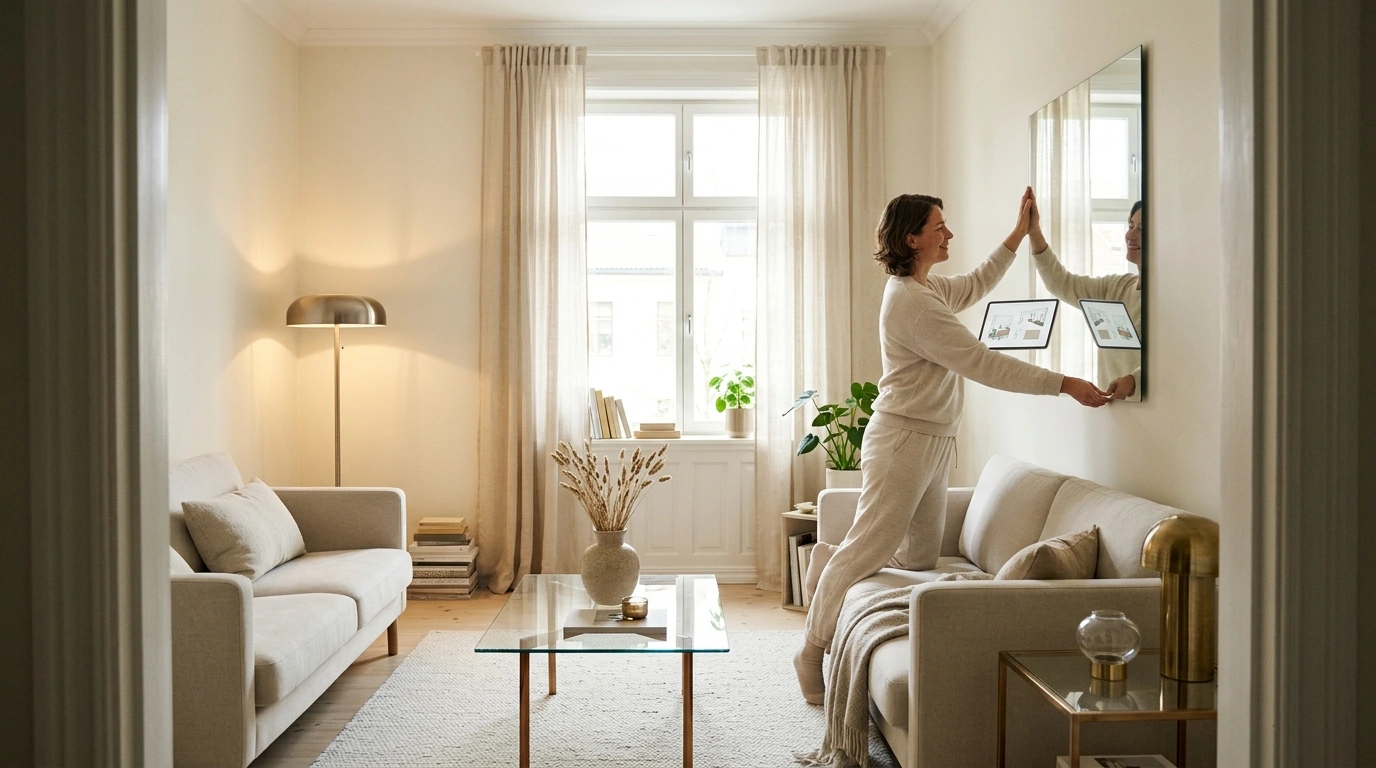
- Place mirrors opposite or adjacent to a window: the goal is to reflect daylight deeper into the room, not just fill a blank wall.
- Pick one larger mirror over many small ones: it reads cleaner and “opens” the space more effectively.
- Angle matters: aim mirrors toward bright views (sky, open doorway, a lit wall) instead of reflecting a dark hall or cluttered corner.
- Add sparkle in small doses: mirrored trays, glass tops, and warm metallic finishes can boost brightness without making the room feel cold.
Window treatments: keep softness, lose the darkness
- Swap heavy panels for light-filtering options: sheers, linen blends, and woven shades maintain privacy while letting in glow.
- Hang rods wider and higher: exposing more glass when curtains are open makes the window look larger and the room feel brighter.
- Protect the top third of the window: that’s where some of the strongest daylight enters, so avoid valances or bulky headers that block it.
- Layer blackout the smart way: if you need blackout for sleep, put blackout behind a sheer so daytime stays bright.
Layer lighting so the room reads bright from every angle
- Use three layers: ambient (overall), task (work zones), and accent (walls, shelves, art).
- Light the darkest corner: a floor lamp in a shadowy corner “pushes back” darkness and expands the room visually.
- Split the brightness: two smaller lamps often feel brighter (and calmer) than one powerful lamp that creates hard contrast.
- Add dimmers where you can: higher maximum brightness is useful, and dimmers help keep the vibe intact at night.
Choose bulbs by purpose: brightness, warmth, and color quality
- Pick lumens by function: higher lumens for kitchens and desks, moderate for living rooms, lower for winding down.
- Match color temperature to mood: warm (2700–3000K) for cozy spaces, neutral (3500K) for balanced clarity, cooler (4000K+) for task-heavy areas.
- Prioritize CRI 90+: high color rendering keeps whites cleaner and colors more lively, especially in dim rooms.
- Keep bulbs consistent within a room: mixing “whites” can make a space feel patchy and less intentional.
Quick bulb guide for a brighter-feeling room
| Use case |
Recommended color temperature |
Typical CRI |
Notes |
| Living room / family room |
2700–3000K |
90+ |
Warm light feels inviting; add accent lighting to prevent dark corners. |
| Kitchen / laundry |
3000–4000K |
90+ |
Neutral-to-cool improves visibility; combine under-cabinet task lights with ceiling ambient. |
| Home office / desk |
3500–5000K |
90+ |
Higher clarity for focus; control glare with shaded fixtures and indirect light. |
| Bedroom |
2700K |
90+ |
Softer warmth supports relaxation; use bedside lamps plus dimmable ambient. |
| Hallway / entry |
3000K |
80–90+ |
Even, welcoming light; consider wall sconces to brighten vertical surfaces. |
For deeper guidance on bulb efficiency and what labels really mean, check the U.S. Department of Energy’s overview on lighting choices and ENERGY STAR’s LED buying guidance. For further reading, see 10 Ideas To Create Light And Airy Room – BRANA Designs.
Rearrange furniture to let light travel
Brighten the floor and soft goods without replacing everything
Small upgrades that create a big brightness jump
Room-by-room mini plan: the fastest sequence that works
Quick reads to help plan your brightness upgrades
FAQ
What color paint makes a room look brighter?
Light, warm off-whites and pale neutrals with higher LRV tend to make rooms look brighter while still feeling cozy. A ceiling that’s slightly lighter than the walls and an eggshell or satin sheen can add more bounce without turning the space glare-y.
Do mirrors really make a room brighter?
Yes—when they reflect a window or another bright area into the room. One larger mirror placed opposite or near a window (and angled toward a bright view) typically brightens more than several smaller mirrors.
What light bulb color is best for a cozy but bright room?
For most cozy spaces, 2700–3000K delivers warmth without feeling dim, especially when paired with CRI 90+ bulbs. Layered lighting (ambient + task + accent) keeps corners from going dark while maintaining a relaxed mood.
Recommended for you













Leave a comment