
A good test drive is a repeatable experiment: same route, same checks, and the same scoring method for every car. When the process is consistent, differences between vehicles become obvious—comfort, visibility, braking feel, and daily usability stop being vague impressions and start becoming clear notes you can compare side-by-side. Use the plan below to schedule multiple drives, spot red flags early, and narrow your finalists without the usual second-guessing.
Before any keys hit your hand, decide what “good” means for your life. Pick 3–5 must-haves (budget ceiling, body style, drivetrain, cargo space, safety tech) plus 3 nice-to-haves. This prevents feature overload and keeps the salesperson’s “but it has…” detours from steering the decision.
Create a standard loop that includes stop-and-go traffic, a rougher surface, a highway merge, and a tight parking segment. Bring the same passengers each time (partner, kids, or a friend who can take notes) and test the same real items: car seat fit, stroller, golf clubs, laptop bag, or whatever you actually carry.
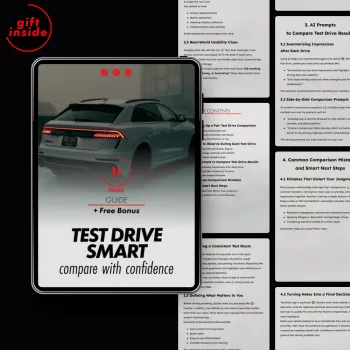
Pack a few essentials: driver’s license, insurance card (if needed), phone mount, charging cable, flashlight (handy for checking tires and panel gaps), and a notepad or scorecard. If possible, schedule drives back-to-back on the same day so conditions stay similar and your impressions stay fresh. For a printable worksheet-style approach, keep one page per vehicle—like the downloadable guide here: Test Drive Smart, Compare With Confidence | Practical Guide for Test Driving Multiple Cars How to Compare Before You Buy.
| Item | What to do | What to note |
|---|---|---|
| Route | Drive the same loop | Where the car felt strongest/weakest |
| Cabin setup | Set seat, mirrors, wheel, climate | Range of adjustment and comfort |
| Tech pairing | Connect phone and start navigation | Time to pair, lag, usability |
| Parking | Do a tight spot and reverse | Visibility, camera quality, steering ease |
| Noise | Drive at 30/50/70 mph | Wind/tire noise and any rattles |
A quick exterior check can prevent wasted time and highlight vehicles that deserve extra scrutiny (especially used cars). Start with tires: look for even wear across the tread. Uneven wear can point to alignment problems, worn suspension components, or chronic underinflation.
Scan for panel gaps, mismatched paint, and foggy headlights. Open all doors and the trunk/hatch; pay attention to lift-over height and how easy it is to load bulky items. Then step back and judge outward visibility—thick pillars and small rear windows can become daily frustrations in parking lots and busy intersections.
Before you leave the lot, confirm basics work: headlights, turn signals, wipers, washers, and seat adjustments. If something simple is broken or “not set up yet,” treat it as useful information about how the car has been maintained.
The cabin is where ownership is won or lost. Spend a few focused minutes getting the seat and wheel right. Check cushion length and thigh support, lumbar adjustment range, headrest position, and whether pressure points show up after 10–15 minutes. A seat that feels “fine” at minute three can feel wrong by the end of a commute.
Confirm you can see the hood line and instrument cluster without strain. Watch for dead spots created by A-pillars—try creeping forward at a stop sign to see how much you have to “peek” around the pillar to check for cross traffic.
To sanity-check safety and operating costs between finalists, compare independent data sources: NHTSA 5-Star Safety Ratings, IIHS vehicle ratings, and EPA fuel economy estimates.
| Category | Car A | Car B | Car C |
|---|---|---|---|
| Comfort (front/rear) | |||
| Visibility & parking | |||
| Ride quality | |||
| Steering & handling | |||
| Noise at speed | |||
| Power & braking feel | |||
| Controls & infotainment | |||
| Cargo & storage | |||
| Driver-assist behavior | |||
| Overall confidence |
If you’re building a consistent route for multiple appointments (and want the drive itself to feel predictable), a simple route-planning resource can help you keep conditions similar: Smart Routes: Plan the Perfect Road Trip – How to Plan a Road Trip Route with Stops Guide.
A structured checklist and scoring method makes multiple test drives easier to compare and harder to regret later. Use a single worksheet for each vehicle so your notes and scores stay consistent across brands and trims. For a ready-to-use format you can print or fill in on your phone, see: Test Drive Smart, Compare With Confidence | Practical Guide for Test Driving Multiple Cars How to Compare Before You Buy.
Plan for 30–60 minutes with a mixed route that includes parking, rough pavement, and highway speeds. Two shorter back-to-back drives of different cars can be more useful than one long drive because comparisons stay fresh.
Start with seating position and visibility, then check low-speed throttle and braking smoothness, and finish with a highway merge and noise at speed. Repeating the same sequence for every car makes differences easier to trust.
Yes when hardware changes: wheel size can change ride comfort, engine/drivetrain can change responsiveness, and seat materials or tech packages can change daily usability. Drive the exact configuration you’re considering whenever possible.











Leave a comment